Ecological Assessment Support System
Data-driven UX and ethical decision support
Delivered 2026
A human-in-the-loop assessment prototype that keeps excluded ecological records visible as context without treating them as accepted evidence.
01 Overview
This project explores how excluded or low-confidence NDFF records can remain visible during VHR ecological assessments without being mistaken for accepted evidence. The prototype helps assessors distinguish a general data gap from a pattern that may justify a follow-up hypothesis, while keeping the final judgement with the assessor.
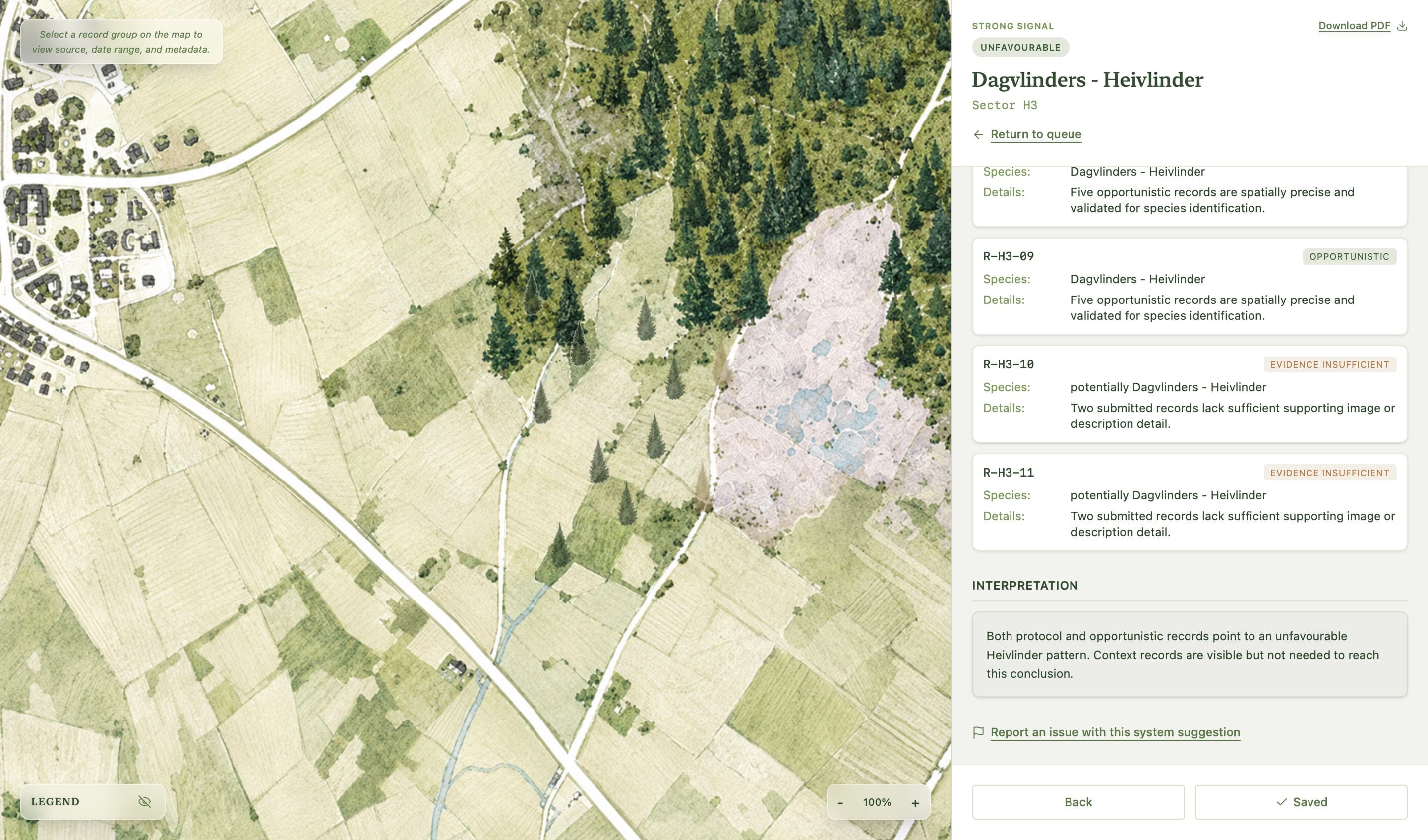
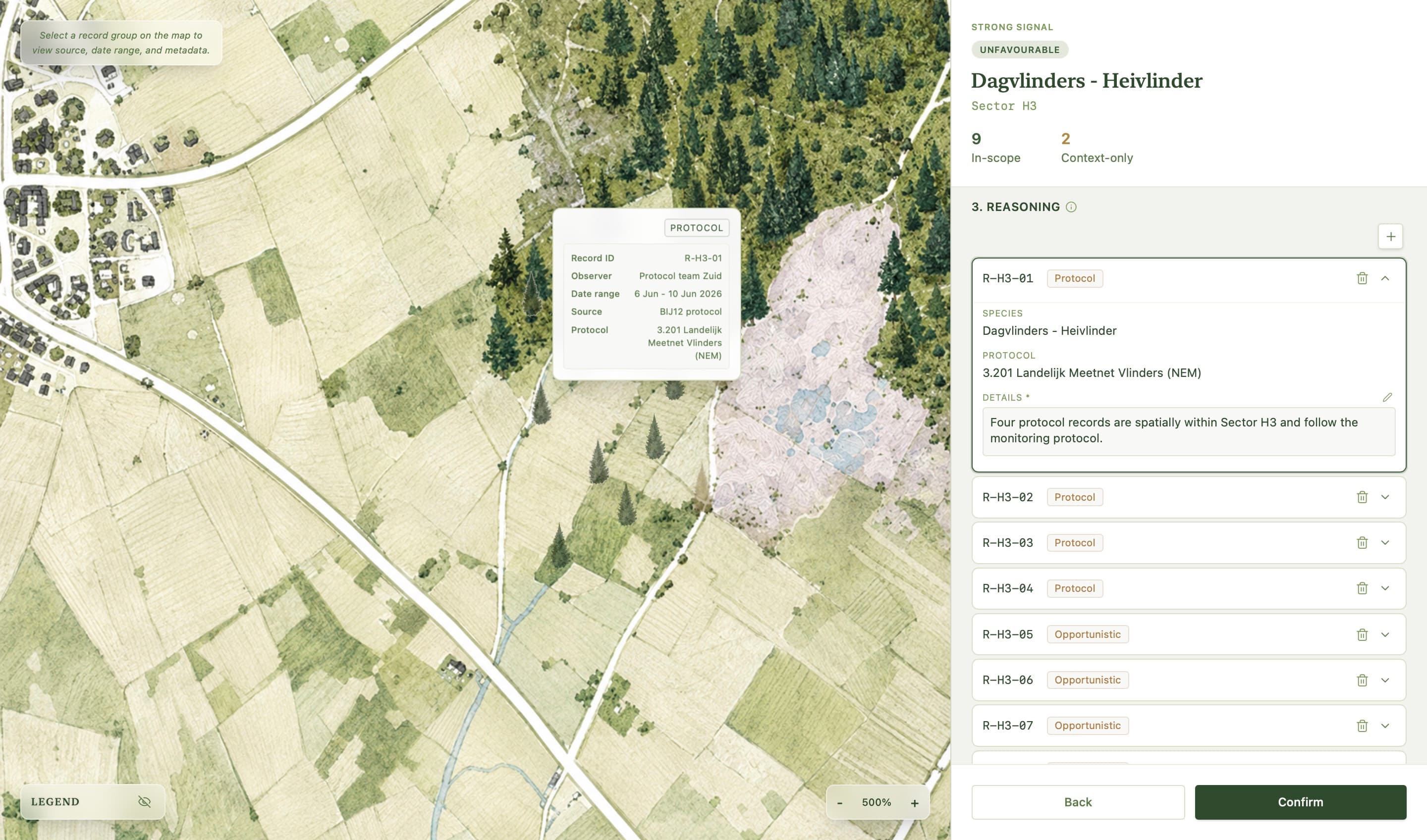
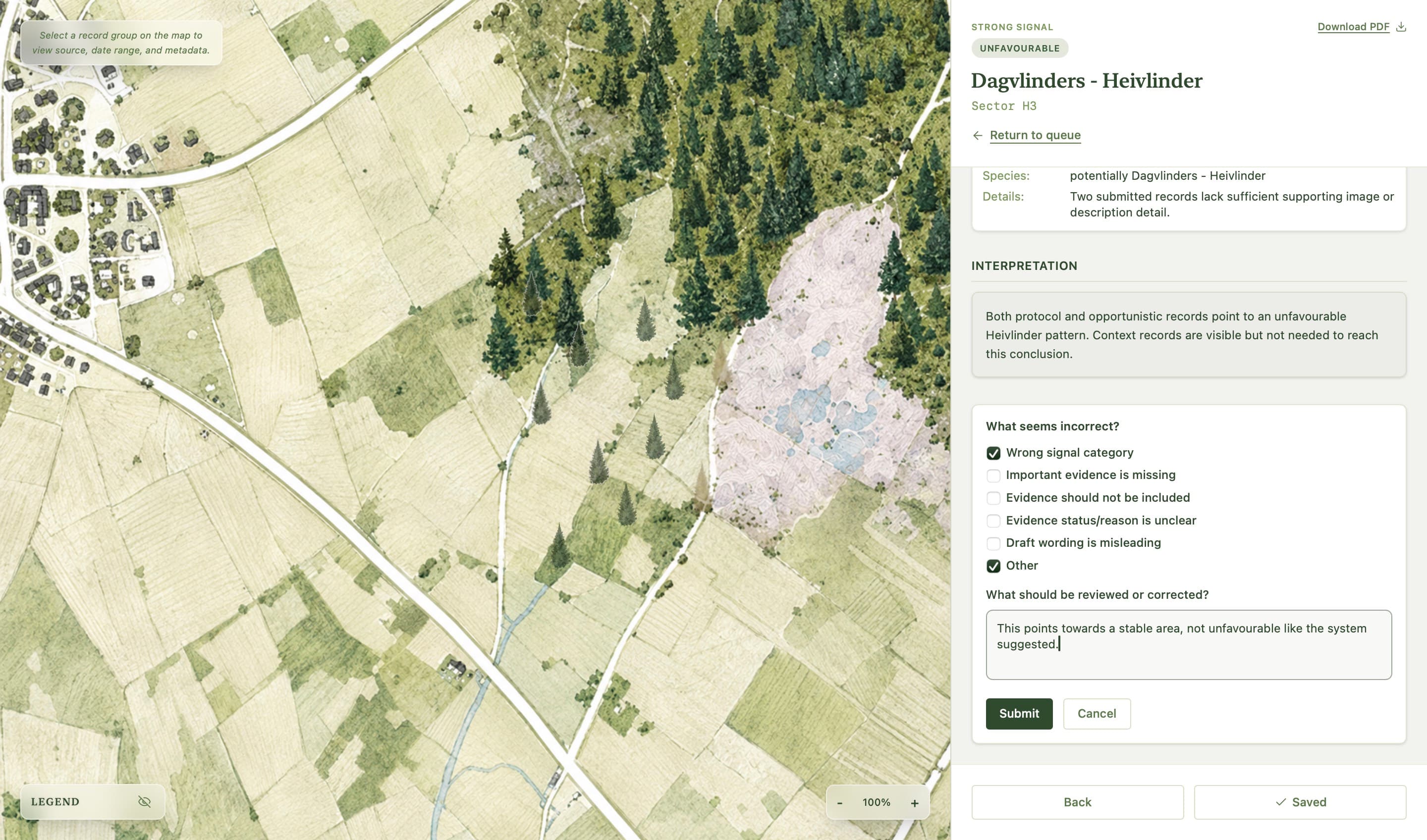
The result is a weekly attention queue and map-based case review flow that makes exclusion reasons, evidence limits, and the assessor's reasoning explicit.
02 Challenge
When low-confidence ecological records are filtered out, assessors can lose useful context and absence can appear more certain than the underlying evidence allows. The interface needed to preserve that context without weakening ecological validation standards or automating the final conclusion.
03 My role
I worked across research synthesis, data logic, taxonomy development, interaction and visual design, prototyping, evaluation, and the final client handover. I translated ecological assessment questions and stakeholder feedback into a review flow that could be discussed and tested.
04 Process
- 01Mapped the difference between observations, accepted evidence, excluded context, and an assessor's final conclusion.
- 02Developed an assessment-signal taxonomy and used notebook experiments to explore how exclusion patterns could inform review priority.
- 03Designed a weekly attention queue, case overview, map-based evidence review, reasoning step, and feedback loop.
- 04Tested the prototype with public participants, experts, and stakeholders, then documented the design logic, evaluation results, source material, and limitations for handover.
05 Outcome
A high-fidelity assessment-support prototype and complete client handover package covering the interaction model, design rationale, taxonomy, evaluation, data experiments, and prototype source. The concept demonstrates how exclusions can remain auditable and reviewable without becoming evidence.
06 Methods
Stakeholder feedback · Qualitative synthesis · Taxonomy design · Jupyter notebooks · Figma prototyping · Evaluation planning · Design handover
07 Reflection
The most important design boundary was to avoid presenting a system suggestion as an ecological fact. The prototype therefore suggests review priority and explains its reasoning, while the assessor decides what context should enter the filed judgement.
Master's client project for BIJ12 / VHR
Areas — Data-driven UX, Ethical Design, Design Research, Data Visualisation, Prototyping